Guides
Barbershop chair turnover in the GTA: Mississauga malls and downtown Toronto strip shops
How walk-in traffic, lease costs and weekend demand shape barbershop chair turnover in Mississauga malls and downtown Toronto strip shops, with worked examples.
What to take away
- Barbershop chair turnover is highest where walk-in traffic is steady and rent per chair stays below roughly 15 percent of revenue.
- Mississauga mall chains deliver predictable weekend and evening walk-ins but carry higher CAM charges; downtown Toronto strip shops offer lower base rent with volatile foot traffic.
- Ontario fire code and building code fit-out rules apply to both, but mall landlords add their own design criteria and inspection fees.
- Toronto Public Health inspects barbershops as personal service settings, so chair scheduling must accommodate cleaning and sterilization time.
- A 900 to 1,200 square foot shop with four to six chairs is the practical format in both markets.
Mall chains versus main-street strip shops: walk-in patterns
A Mississauga mall chain barbershop sits inside a managed centre such as Square One, Erin Mills Town Centre or Heartland Town Centre. Walk-in traffic arrives in waves tied to mall hours, cinema schedules and grocery anchors.
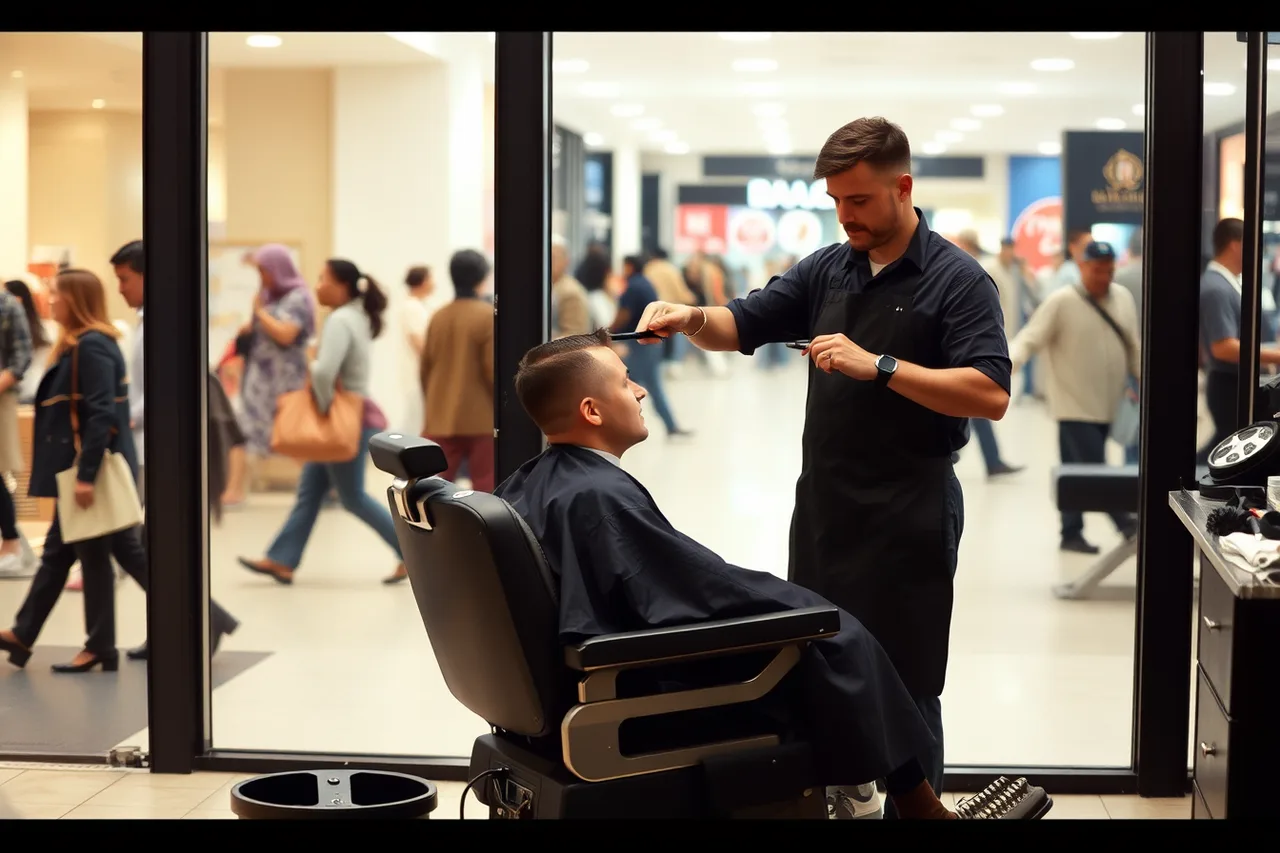
Saturday afternoons and weekday evenings after 5 p.m. produce the densest walk-in clusters. Chair turnover in these locations depends on capturing shoppers who did not book ahead.
Downtown Toronto strip shops along Queen Street West, Danforth Avenue or Bloor Street West rely on a different pattern. Office workers, students and residents pass on foot throughout the day. Walk-in traffic peaks at lunch and again after work.
A downtown Toronto barbershop may see fewer total passersby than a mall, but the ones who enter are more likely to sit down without an appointment.
Mall chains benefit from shared marketing, centralized waste removal and consistent hours. Strip shops benefit from lower visibility costs and the ability to set their own schedule. Neither pattern guarantees full chairs in the Greater Toronto Area. Operators who track arrival times by hour can staff to the peaks rather than guessing.
Foot traffic counts help. Stand outside a candidate site on a Tuesday, a Saturday and a Sunday, and count people who pass within ten metres. Compare those counts with the number who enter similar shops nearby. For a wider comparison of Canadian markets, see markets for barbershop.
Lease costs and CAM charges in Mississauga and downtown Toronto
Commercial lease per square foot varies widely across the Greater Toronto Area. Mississauga mall chains typically quote base rent plus additional rent for common area maintenance, or CAM.
Lease cost: mall vs strip shop
Mississauga mall chain
- Base rent per sq ft
- $35-$55
- CAM per sq ft
- $15-$25
- Typical term
- 5-10 years
- CAM share of base
- 40-60%
Downtown Toronto strip shop
- Base rent per sq ft
- $40-$70
- CAM per sq ft
- $5-$10
- Typical term
- 3-5 years
- CAM share of base
- lower
CAM covers snow clearing, parking lot lighting, mall security and shared utilities. In a regional mall, CAM can add 40 to 60 percent to the base rent figure.
Downtown Toronto strip shops usually have lower CAM because there is no enclosed mall to maintain. Base rent per square foot, however, is often higher.
A prospective operator should ask for the gross occupancy cost, not just base rent. Gross occupancy cost includes base rent, CAM, property taxes and insurance. Compare that figure against projected revenue per chair. If gross occupancy cost exceeds 15 percent of revenue, chair turnover must be very high to stay profitable.
Lease costs and CAM charges
Base rent per sq ft
- Mississauga mall chain
- $35 to $55
- Downtown Toronto strip shop
- $40 to $70
CAM per sq ft
- Mississauga mall chain
- $15 to $25
- Downtown Toronto strip shop
- $5 to $10
Typical term
- Mississauga mall chain
- 5 to 10 years
- Downtown Toronto strip shop
- 3 to 5 years
These ranges are illustrative. Actual quotes depend on frontage, corner exposure and landlord incentives. The Canadian Federation of Independent Business tracks small-business rent and regulation costs through its Research & Economic Analysis | CFIB work, which operators can use to benchmark their own numbers.
Negotiate on term and incentives. Landlords in a soft market may offer a rent-free fit-out period or a contribution to construction. Ask what the previous tenant paid before you accept the first quote.
Residential rents also signal local spending power. The 2025 Rental Market Report | CMHC compares major centres, and Toronto consistently ranks among the most expensive. High residential rent means clients have less discretionary income, which can affect how often they return.
Before committing to a lease built on those costs, work through the pricing side of a profitable barbershop to confirm your service prices cover the rent you are considering.
Weekend and evening demand by location type
Weekend demand barbershop patterns differ by location. Mississauga mall chains see strong Saturday traffic from families shopping and from teenagers who come in groups. Sunday demand depends on mall hours; some centres open at noon, which pushes walk-ins later. Evening demand is moderate because malls close by 9 p.m.
Weekend and evening staffing by location
Mississauga mall chain
- Saturday
- 2 barbers
- Sunday
- 1 barber
- Evening
- moderate, closes 9pm
- Event nights
- little change
Downtown Toronto strip shop
- Saturday
- strong, 2-3
- Sunday
- softer
- Evening
- strong, 3 barbers Thu-Fri
- Event nights
- triple walk-ins
Downtown Toronto strip shops see weekend demand from residents running errands and from visitors. Saturday can be strong, but Sunday is often softer unless the shop sits near a popular brunch strip. Evening demand is stronger downtown because offices, restaurants and bars keep foot traffic moving until late.
A shop that relies on walk-in traffic barbershop volume should staff two barbers on Saturday and one on Sunday in a mall. A downtown strip shop may need three barbers on Thursday and Friday evenings. These are starting points, not rules. Track your own hourly counts for eight weeks before locking a schedule.
Event days change the pattern. A concert at Scotiabank Arena or a festival on the Danforth can triple evening walk-ins downtown, while a mall sees little change unless the centre runs its own promotion. Keep a flexible roster for those nights.
Hiring and scheduling decisions also shape expansion plans. For a structured way to read demand signals, see Barbershop expansion.
Fit-out, fire code and building code constraints
Ontario fire code and building code fit-out rules apply to every barbershop, whether in a mall or on the strip. The Fire Code sets out obligations for premises, including means of escape, fire separations and occupancy limits. You can read the consolidated statute at Ontario Fire Code.
The Building Code governs renovations, plumbing rough-ins, electrical work and barrier-free access. The relevant statute is also available at Ontario Building Code.
Mall landlords add their own design criteria. They may require specific storefront glazing, signage sizes, floor finishes and after-hours access routes. These requirements can add thousands of dollars to a fit-out. Strip shops give more freedom, but the landlord still controls structural changes and exterior signage.
Budget for permits. A fit-out typically needs a building permit, an electrical permit and sometimes a plumbing permit. Inspections must pass before you open, so allow weeks for scheduling.
Toronto Public Health inspects barbershops as personal service settings. Inspectors check for clean towels, disinfected tools, handwashing sinks and proper waste disposal. The City of Toronto publishes its health and infection-control guidance through Health & Wellness, City of Toronto.
An inspection failure can force a shop to close chairs until fixes are made, which directly cuts chair turnover.
A practical fit-out checklist:
- Confirm occupancy load with the local building department.
- Install a handwashing sink in the service area, not just the washroom.
- Provide closed storage for clean and soiled linens.
- Use surfaces that can be disinfected between clients.
- Post the most recent public health inspection result.
Review Barbershop startup and market realities for a realistic view of opening and fit-out costs in Ontario.
Choosing a GTA location for chair turnover
Start with a simple worked example. Suppose you open a four-chair shop in a Mississauga mall. Gross occupancy cost is $60 per square foot on 1,000 square feet, or $60,000 per year.
Four-chair shop: mall vs strip
- $842,000annual revenue, Mississauga mall
- $524,000annual revenue, downtown strip
- 7%rent as share of revenue, mall
- 13%rent as share of revenue, strip
Each chair generates $45 per hour and turns over 1.8 clients per hour during peak hours. At 50 peak hours per week, one chair brings in about $4,050 per week. Four chairs bring in about $16,200 per week, or roughly $842,000 per year.
Rent works out to about 7 percent of revenue, which leaves room for labour, supplies and profit.
Now run the same numbers for a downtown Toronto strip shop at $75 per square foot gross on 900 square feet, or $67,500 per year. If walk-in traffic is less predictable and each chair turns over 1.4 clients per hour during 40 peak hours, weekly revenue per chair is about $2,520.
Four chairs bring in about $10,080 per week, or roughly $524,000 per year. Rent is about 13 percent of revenue.
The margin is thinner, so every empty chair hurts more. These figures are illustrative, but they show why chair turnover matters more than headline rent. A cheaper lease with weak walk-in traffic can produce lower profit than a pricier lease with steady turnover.
Chair-to-catchment ratios matter. A downtown block may hold more than a dozen shops within walking distance, so each one captures a smaller share. A Mississauga mall draws from a wider trade area with fewer direct competitors inside the centre.
If you plan to attract clients through search, Getting a barbershop owners found locally explains how local visibility affects walk-in volume.